◇
Institutional visibility
We identify how, where, and why AI is used across the school.
Bloom Edtech helps private schools in Peru understand their AI readiness and move forward with educational purpose, responsibility, and professional judgment.

Complete a short self-assessment to identify the practices your school reports, information that still needs confirmation, and areas that deserve a deeper conversation.
The result is indicative and based on institutional responses. It is not an audit or a compliance assessment.
It does not represent any school or verify its practices.
Complete the questions, receive an initial reading of declared practices, and identify when institutional evidence should be examined more deeply.
One question at a time, with clear options.
A reading based on the school’s responses.
Visible signals even when the overall score is high.
Understand when professional evidence review is needed.
Meet the founder
Institutional video · Coming soonBloom Edtech grows from an educator’s perspective and the realities schools face: limited time, diverse teams, families with questions, and decisions that require judgment.
We combine educational practice, responsible AI use, and institutional strategy to help schools make clearer decisions.
Clear services for every part of the school community.
Diagnostics, governance, responsibilities, and institutional decisions.
AI use with judgment, learning design, assessment, and human review.
Responsible use, verification, reasoning, and transparency in learning.
Clear conversations about tools, boundaries, and wellbeing at home.
The free diagnostic starts a conversation. The Professional Audit examines a school’s actual practices, tools, evidence, and decisions to guide its next steps.
We identify how, where, and why AI is used across the school.
We listen to leaders, academic teams, and administrative staff.
We provide clear priorities for responsible decisions.
The initial scope is confirmed with each institution. Bloom reviews practices and documents; it does not replace legal advice, specialist cybersecurity work, or regulatory certification.
An initial view of the Professional School AI Audit. The complete review is adapted to each school’s context and developed through the audit process.
Institutional goals, decisions, and readiness to lead AI use.
Pedagogical practice, educator confidence, and meaningful learning design.
Usage patterns, required support, and responsible, transparent practices.
Expectations, assessment design, disclosure of use, and human judgment.
Policies, safeguards, tools, and clear responsibilities.
Training, family communication, and practical next steps.
The full diagnostic framework, domain questions, and specific recommendations are delivered as part of the Professional School AI Audit.
Duration and pricing are confirmed based on school size, participating teams, and available evidence.
Tell us about your school and receive a clear proposal before making any commitment.
Bloom will respond by email to arrange an initial conversation and define an appropriate scope.
The report does not require the school to purchase additional services. When the audit identifies a priority need, Bloom may offer focused support to turn it into institutional practice.
Ask about the Professional School AI Audit ↗The Professional School AI Audit is not a certification or a legal-compliance determination. Conclusions depend on the agreed scope and available evidence.
Clear virtual sessions adapted to the school’s context.
Choose the audience and request a date. The final proposal is confirmed by email before booking.
Strategy and institutional decisions.
Responsible use with pedagogical judgment.
Critical thinking and responsible use.
Supporting AI use at home.
Questions: bloomingmindsflorida@gmail.com
Ideas for starting an informed conversation. Free resources reveal areas to review; the Professional Audit examines the school’s specific situation.
Fifteen questions and an indicative result based on what your institution reports.
Open diagnostic ↗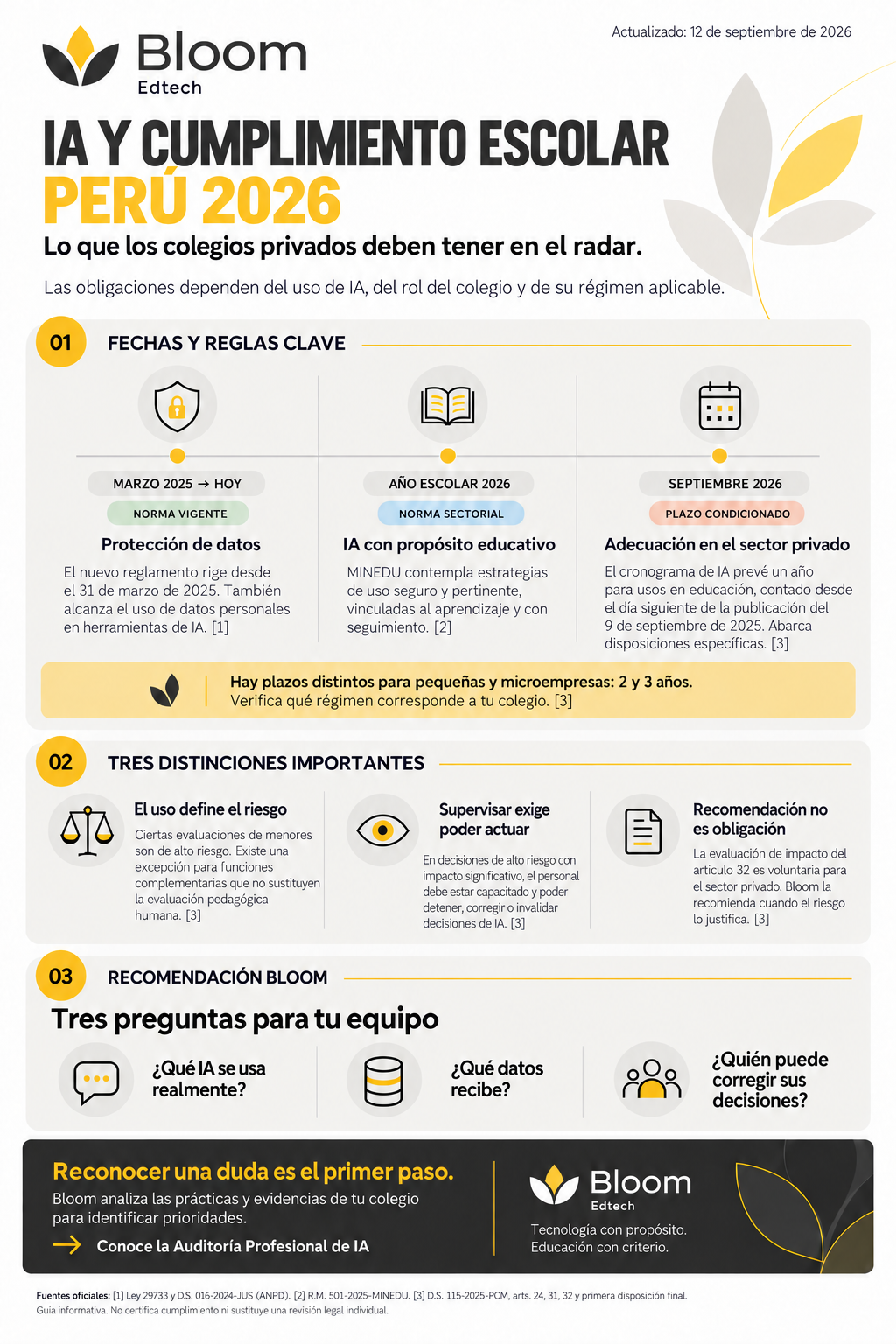
Informational infographic created by Bloom.
View infographic ↗A short human-oversight checklist to begin internal discussion.
Download Excel ↓A strategic question guide for school leaders who want to make better-informed AI decisions.
Download PDF guide ↓Responsible AI use in a school requires reflection, evidence review, and ongoing support. Bloom Architect is a future direction, not a tool currently available.
Recognize declared practices and open questions.
Examine evidence and prioritize according to the school’s context.
Institutional governance and educator development according to identified needs.
Future learning support under teacher oversight.
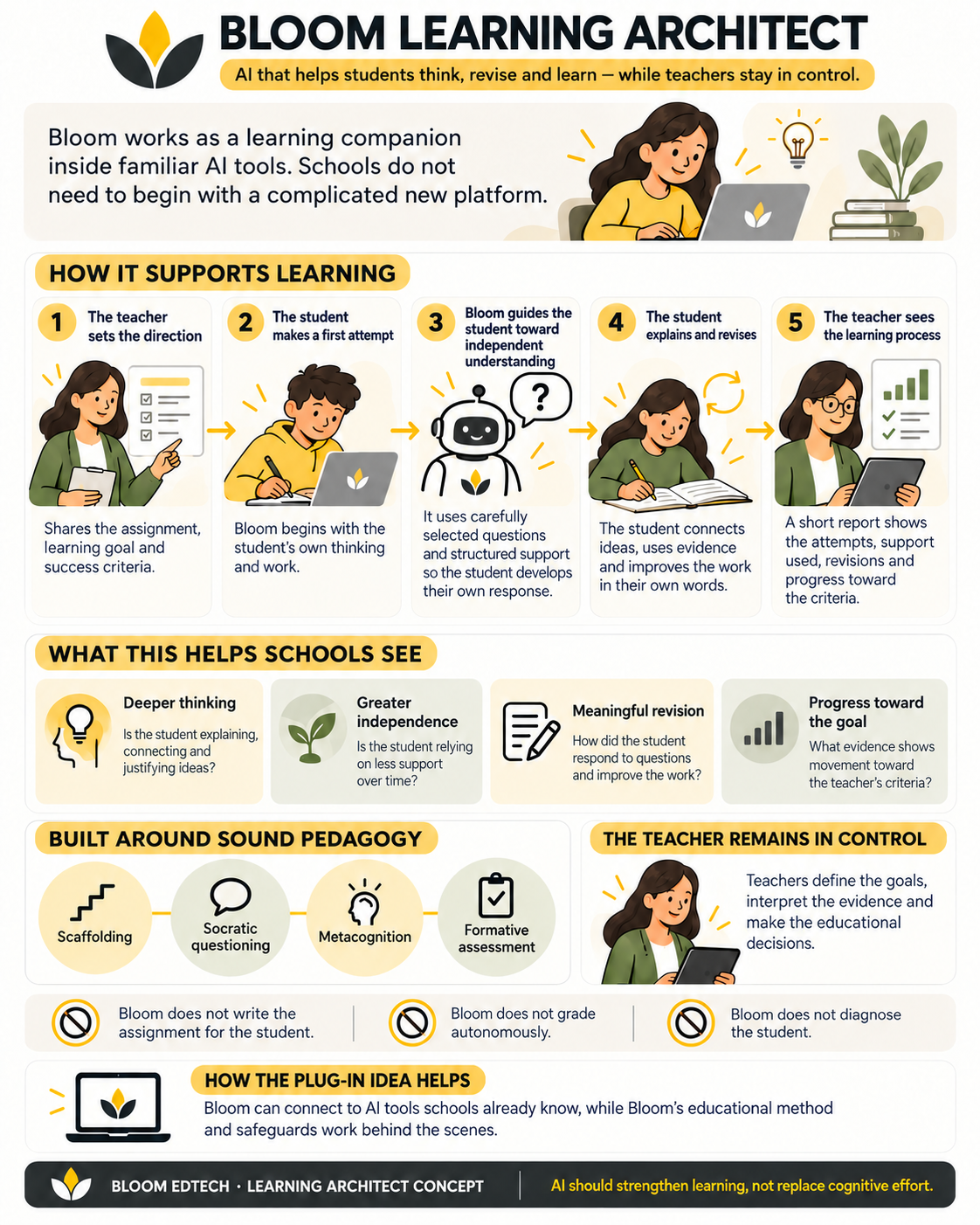
Bloom Architect does not diagnose learning styles or label students. Within a specific task, it examines how a student interprets the prompt, what evidence of understanding appears in the work, and which supports help the student revise ideas and progress more independently.
The challenge is not whether students will use AI, but how they will use it. When a tool replaces processes students need to practise, it can create unproductive cognitive offloading. Bloom Architect aims to make visible how students select, connect, explain, and revise ideas. Educators and school professionals retain interpretation and decision-making.
The first prototype will test a complete cycle: teacher-defined goals and criteria, a student attempt, adaptive Socratic support, revision, and a short report for teacher interpretation.
Pedagogical design basis. The prototype draws on Teaching for Understanding and Project Zero thinking routines to define goals, make reasoning visible, and promote explanation, connection, revision, and transfer. Teaching for Understanding ↗ · Thinking routines ↗
These references guide the pedagogical design; they do not by themselves prove that Bloom Architect improves learning. The first pilot will measure understanding, revision, and independence before making impact claims.
After the Professional Audit, Bloom may support the school with institutional governance and educator development according to its needs. Bloom Govern and Bloom Learn remain in development; no membership is offered at this stage.
Support schools in the responsible adoption of artificial intelligence by connecting strategy, governance, educator development, and learning.
Advance an education system where AI expands educator capacity and personalizes learning without replacing human thinking or professional judgment.
Founder video · Coming soon.